# 3ds Max

{% hint style="info" %}
Import data extracted as OBJ or FBX. or use Zbrush's GoZ feature. (A tool that directly transfers to 3ds Max)\
\
For detailed information on GoZ, please refer to [this link.](https://help.maxon.net/zbr/en-us/)
{% endhint %}

{% hint style="warning" %}
For a single clothing upload standard, please work with low-polygon as Tri less than 20,000.
{% endhint %}

1. Import the clothing as OBJ.

<figure><img src="https://328555605-files.gitbook.io/~/files/v0/b/gitbook-x-prod.appspot.com/o/spaces%2Fqbl3tKh4Tqarpg8Dmgw2%2Fuploads%2FmHRkzh5W7XRqM9N9TJ6V%2Fimage.png?alt=media&#x26;token=3aacc8ac-216d-4fc1-977e-94cbf3355cce" alt=""><figcaption></figcaption></figure>

2. Convert Editable Mesh to Editable Poly. And name the mesh HIGH for easier visibility.

<figure><img src="https://328555605-files.gitbook.io/~/files/v0/b/gitbook-x-prod.appspot.com/o/spaces%2Fqbl3tKh4Tqarpg8Dmgw2%2Fuploads%2F1ZkOdp1ctJLwam87Jznz%2Fimage.png?alt=media&#x26;token=13743d23-5ebc-4c76-843e-ff4e87d6d36a" alt=""><figcaption></figcaption></figure>

3. Select the high-polygon, press Ctrl+V, and create a mesh to be made into LOW polygon. Then select Retopology from the Modifier List.

<figure><img src="https://328555605-files.gitbook.io/~/files/v0/b/gitbook-x-prod.appspot.com/o/spaces%2Fqbl3tKh4Tqarpg8Dmgw2%2Fuploads%2F2fkRU19VhSLvnf3Ek6MT%2Fimage.png?alt=media&#x26;token=6f855b75-d121-469d-a17b-6fc5c6f954a1" alt=""><figcaption></figcaption></figure>

4. Set Face Count to 2000 and **\[Compute]**.

{% hint style="info" %}
Clothes made in CLO or Marvelous can have separate pattern parts. \
\
If you have made separate sleeves or parts in Zbrush as well, it's normal for them to disconnect. In such cases, you must connect the vertices during the topology process.
{% endhint %}

<figure><img src="https://328555605-files.gitbook.io/~/files/v0/b/gitbook-x-prod.appspot.com/o/spaces%2Fqbl3tKh4Tqarpg8Dmgw2%2Fuploads%2FR6Baf96qEU4ue9SLJ2V1%2Fimage.png?alt=media&#x26;token=72358438-7e7d-496a-98e8-f0342fb137b0" alt=""><figcaption><p>Mesh retopolized to selected approximation</p></figcaption></figure>

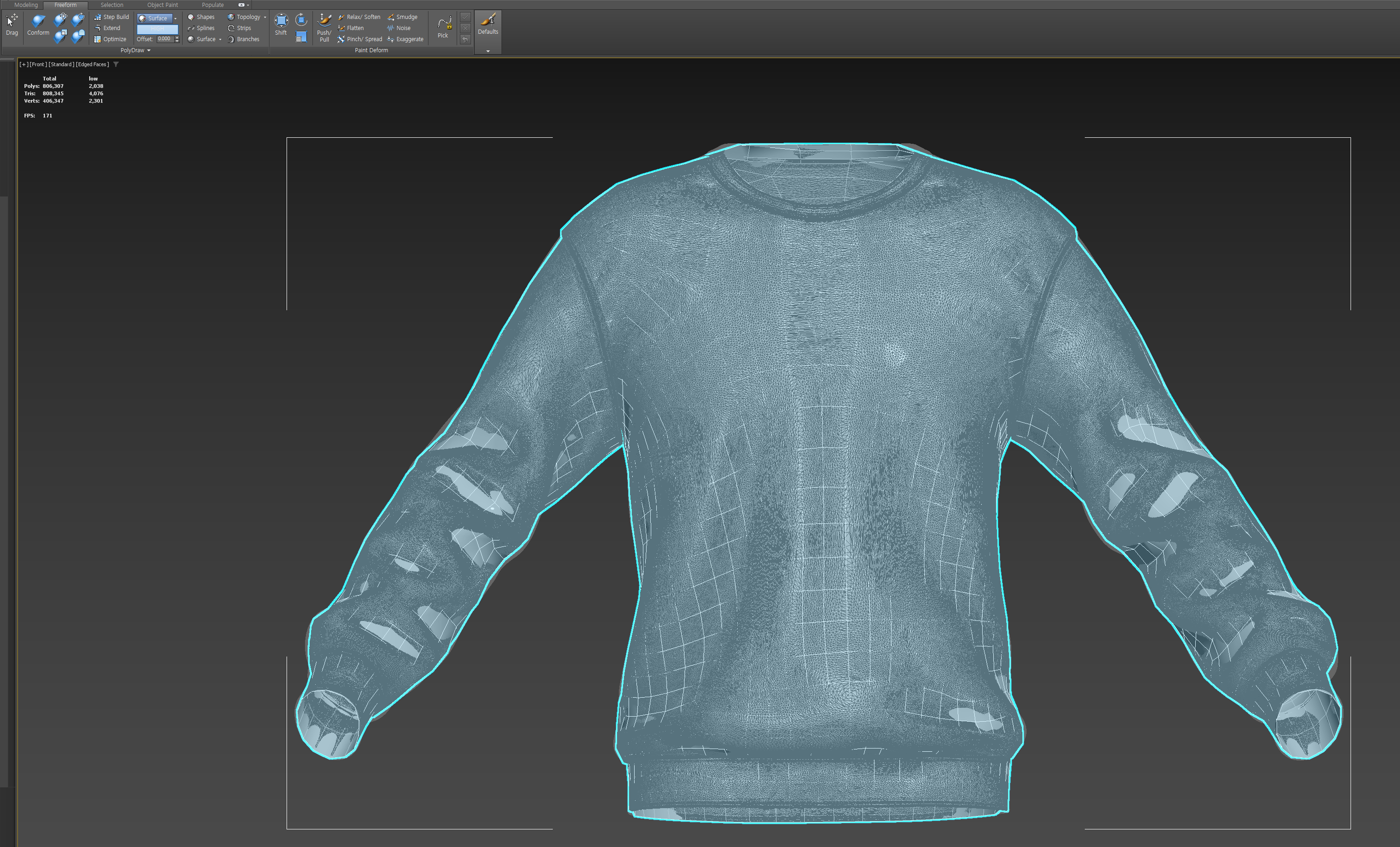
5. After retopology is complete, select the mesh named LOW, change to Surface - \[Draw On: Surface], then Pick and select the high-polygon to retopologiz&#x65;**.**

<figure><img src="https://328555605-files.gitbook.io/~/files/v0/b/gitbook-x-prod.appspot.com/o/spaces%2Fqbl3tKh4Tqarpg8Dmgw2%2Fuploads%2FYwzHAkJEpWesOMuZjUBA%2Fimage.png?alt=media&#x26;token=a887d62a-814d-444d-be72-46d0c0d4789f" alt=""><figcaption></figcaption></figure>

<figure><img src="https://328555605-files.gitbook.io/~/files/v0/b/gitbook-x-prod.appspot.com/o/spaces%2Fqbl3tKh4Tqarpg8Dmgw2%2Fuploads%2F7oZCSKDi5IASrDfqJEac%2Fimage.png?alt=media&#x26;token=92ebe12a-605a-4e4f-abb2-07e0aa2ae4dd" alt=""><figcaption></figcaption></figure>

6. Set the Offset to about 0.2 and use the Conform brush to sculpt the LOW mesh.

<figure><img src="https://328555605-files.gitbook.io/~/files/v0/b/gitbook-x-prod.appspot.com/o/spaces%2Fqbl3tKh4Tqarpg8Dmgw2%2Fuploads%2FP0ffbA1XB2XxPVqjrUcZ%2Fimage.png?alt=media&#x26;token=72683cff-1108-43fc-b2e0-554174bfc0c2" alt=""><figcaption></figcaption></figure>

{% hint style="info" %}
For detailed tool explanations on retopology, please refer to [Autodesk's official YouTube](https://www.youtube.com/watch?v=GUeLVxQairM) channel, or various YouTube tutorials.
{% endhint %}

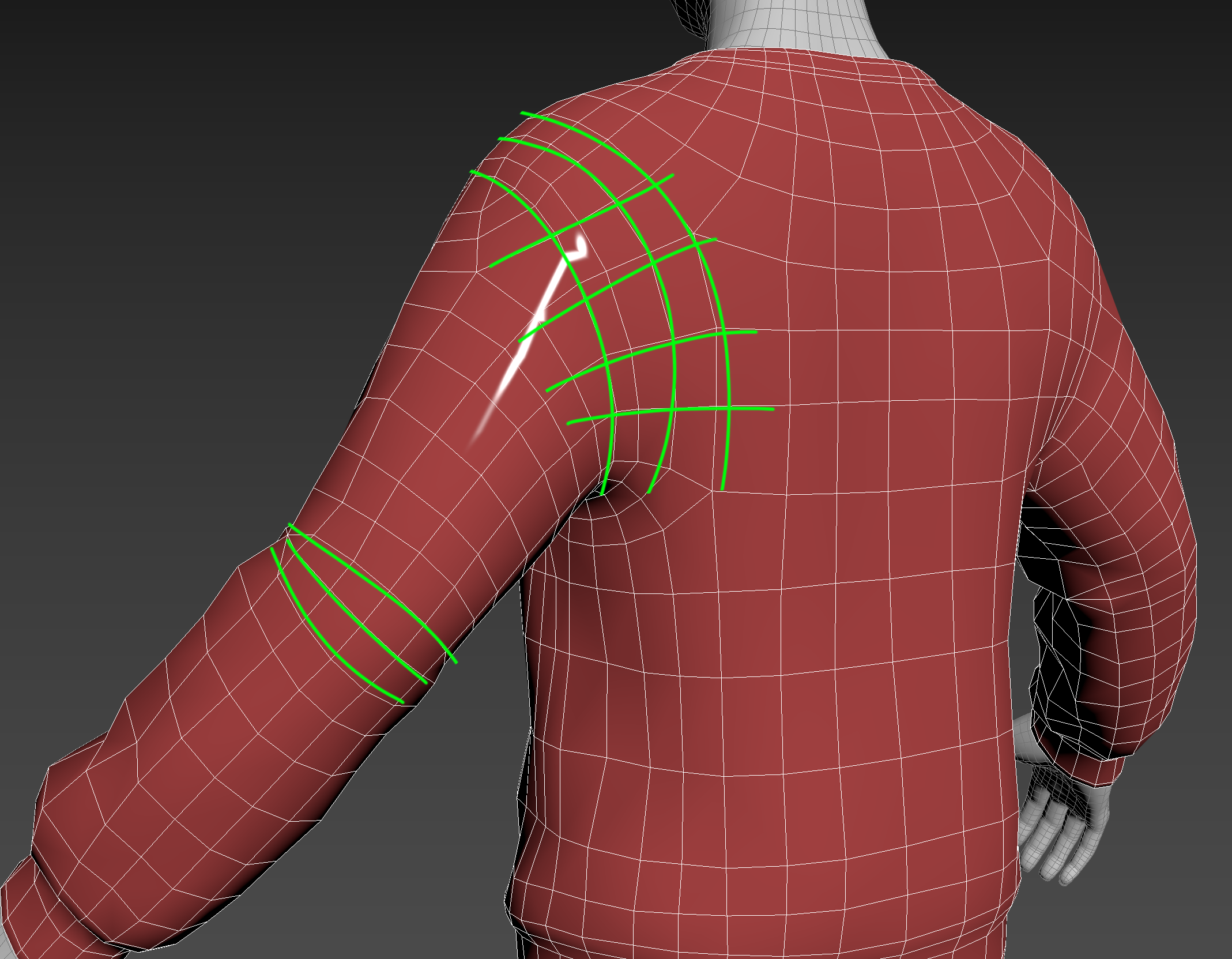
7. Work as much as possible along the wire flow of the base model.

Properly modeling the mesh to bend is also important. When the avatar moves, the mesh points move in alignment with the unseen internal skeleton. Therefore, the number of vertices used determines how intricately an item can bend. If a part of the avatar bends a lot, arrange the joint seams closely to smooth out the curves.

<figure><img src="https://328555605-files.gitbook.io/~/files/v0/b/gitbook-x-prod.appspot.com/o/spaces%2Fqbl3tKh4Tqarpg8Dmgw2%2Fuploads%2Foj5qOiOPhP4J8LMEae0o%2Fimage.png?alt=media&#x26;token=498ac598-264a-43c1-841b-bfdcfdc0c178" alt=""><figcaption></figcaption></figure>

{% hint style="info" %}
It's important to evenly distribute the overall spacing of the wire. Be aware of working the edges of the parts with movement range such as armpits, elbows, pelvis, knees, etc.
{% endhint %}

{% hint style="info" %}
For the waist, please organize the wire neatly in a straight line as much as possible.\
\
For joint areas, work with a radial method for the wire.
{% endhint %}

<figure><img src="https://328555605-files.gitbook.io/~/files/v0/b/gitbook-x-prod.appspot.com/o/spaces%2Fqbl3tKh4Tqarpg8Dmgw2%2Fuploads%2FUnAzNP7SInbfHKvAQ2Ka%2Fimage.png?alt=media&#x26;token=3e9d9981-827c-422c-9d61-0e321379dd8d" alt=""><figcaption></figcaption></figure>

8. Maintain the thickness at the end of the mesh.

<figure><img src="https://328555605-files.gitbook.io/~/files/v0/b/gitbook-x-prod.appspot.com/o/spaces%2Fqbl3tKh4Tqarpg8Dmgw2%2Fuploads%2FSuwRrgtU5hU15v96baul%2Fimage.png?alt=media&#x26;token=ec616869-bb9b-4a0c-9a14-08e65d72fdfe" alt=""><figcaption></figcaption></figure>

<figure><img src="https://328555605-files.gitbook.io/~/files/v0/b/gitbook-x-prod.appspot.com/o/spaces%2Fqbl3tKh4Tqarpg8Dmgw2%2Fuploads%2FAFNSnJ8z6SVVN9q99Odn%2Fimage.png?alt=media&#x26;token=12bd8c61-d400-41b0-9205-21c342de476e" alt=""><figcaption></figcaption></figure>

{% hint style="info" %}
To get good results when baking normal maps, the low-polygon mesh must sufficiently wrap the high-polygon mesh, and it is good to make it at about 45 degrees at the end.
{% endhint %}

9. Close all open meshes.

Even if you haven't made a high-poly, please close the inside mesh so it's not visible.&#x20;

Use shortcut 3 to select the open edges, then right-click and choose the Cap option to close the mesh,

<figure><img src="https://328555605-files.gitbook.io/~/files/v0/b/gitbook-x-prod.appspot.com/o/spaces%2Fqbl3tKh4Tqarpg8Dmgw2%2Fuploads%2FCldUkvGqwTXOrrMWhvvX%2Fimage.png?alt=media&#x26;token=46b2db04-88cc-4b1f-b38f-25de73e8028a" alt=""><figcaption></figcaption></figure>

use the Insert tool to pull the edges to the end and collapse them.

<figure><img src="https://328555605-files.gitbook.io/~/files/v0/b/gitbook-x-prod.appspot.com/o/spaces%2Fqbl3tKh4Tqarpg8Dmgw2%2Fuploads%2FFC3HlATX0GV5rRYL311f%2Fimage.png?alt=media&#x26;token=b4d89862-5474-4a79-85b1-84f59b482fe8" alt=""><figcaption></figcaption></figure>

Then, select the center vertex and pull it inward without interfering with the overall shape of the mesh.

<figure><img src="https://328555605-files.gitbook.io/~/files/v0/b/gitbook-x-prod.appspot.com/o/spaces%2Fqbl3tKh4Tqarpg8Dmgw2%2Fuploads%2FiN44Q6mx3ZZ7SqUA9G8R%2Fimage.png?alt=media&#x26;token=957bfabb-a3b9-4941-b088-59546c6b5639" alt=""><figcaption></figcaption></figure>

Please do the same for sleeve ends or waist areas.

<figure><img src="https://328555605-files.gitbook.io/~/files/v0/b/gitbook-x-prod.appspot.com/o/spaces%2Fqbl3tKh4Tqarpg8Dmgw2%2Fuploads%2Fmq1pI6e6VKJ4DW2upIuz%2Fimage.png?alt=media&#x26;token=78d261df-caf4-44a2-908e-70254352ec0d" alt=""><figcaption></figcaption></figure>

<figure><img src="https://328555605-files.gitbook.io/~/files/v0/b/gitbook-x-prod.appspot.com/o/spaces%2Fqbl3tKh4Tqarpg8Dmgw2%2Fuploads%2FcWoxOer0UPda1eSWUpjO%2Fimage.png?alt=media&#x26;token=4041cd6d-6323-4805-ac01-c2a8e6b073ef" alt=""><figcaption></figcaption></figure>

{% hint style="success" %}
The mesh should be neatly organized when fitted over the base model.
{% endhint %}